Your path to efficient ESD management
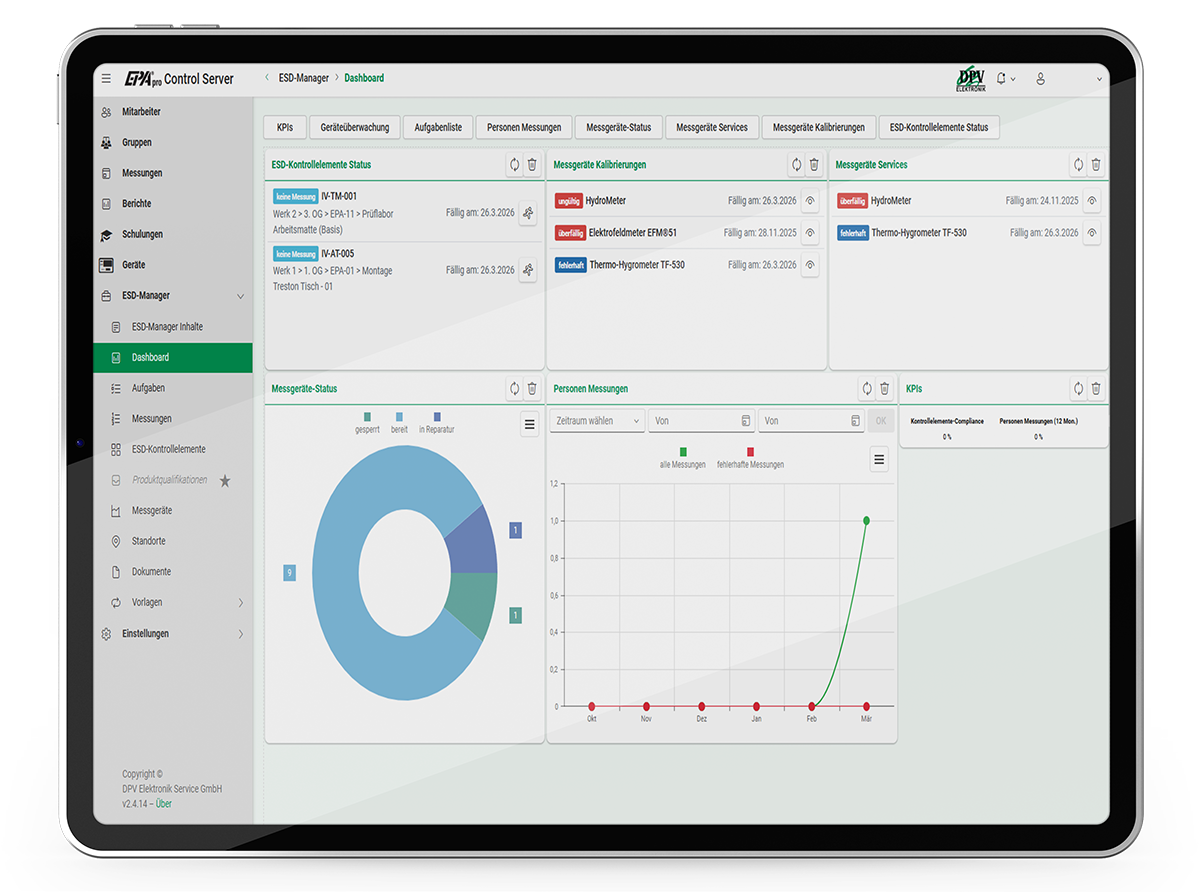

Dashboard

ESD control elements

ESD measurements

Measuring devices

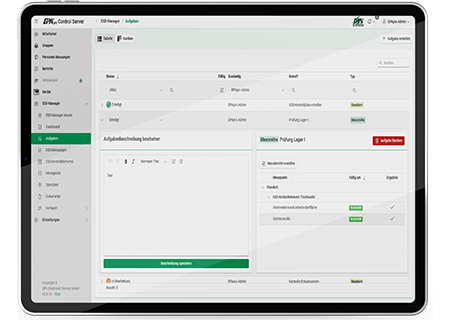
Tasks

Locations

Templates

Startseite » EPApro » EPApro ESD Manager
With the EPApro® ESD Manager, you can centrally and efficiently create, manage and document all tasks, data and processes of your ESD control program – in electronics manufacturing, automotive, medical technology and more.
With the EPApro® ESD Manager, we offer, as an extension to the Control Server, a powerful, user-friendly, audit-compliant and audit-proof software solution for your ESD management.
All tasks, data and processes of your ESD control program are managed digitally in a central location on your Control Server – flexible, modular and independent of measuring device manufacturers.
The EPApro® ESD Manager can be seamlessly integrated into your existing IT infrastructure and backup routines. This ensures central and secure management of all relevant measurement data on your EPApro® Control Server.
You benefit from a consistent, reliable data basis and optimized workflows across your entire ESD management.
ESD management needs a stable foundation. That is exactly why we developed the Control Server. It is the central system where all data and processes come together, and the prerequisite for using the ESD Manager. With the Control Server, you create:
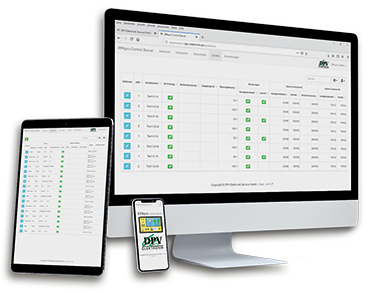
It extends the Control Server with exactly the functions you are missing in your day-to-day work:
The key point is: all data and workflows are documented directly on the Control Server, so you benefit from a consistent, secure and traceable data basis.
The ESD Manager supports the entire inspection process — structured, standards-compliant, fully digital.
Everything at a glance
Visualize your own dashboard with a wide range of components and display options for internal analyses and management reviews. Keep an eye on inspection processes, irregularities and developments in your ESD management at all times.
The basis of all measurements
Define as many ESD control elements as you like from the master data, each subject to an individual inspection cycle, such as tables, table mats, tools, carts, floors and much more. Set measurement limit values per control element, define the measuring device to be used, and add images or custom geometries with exact measurement positions so that any employee can carry out and log a measurement without training effort.
Audit-proof inspection
Get an overview of all completed and upcoming measurements of the defined ESD control elements, including measurement results and day-by-day logging. Create new measurements or entire measurement series with self-defined inspection intervals, and export individual measurement reports at any time, e.g. for an audit.
Full control over your measuring devices
With integrated device management, you can keep track of all measuring devices at all times. Record calibration status, maintenance and service intervals. Automatic reminder functions help you plan maintenance and calibrations in good time. Our system works independently of which measuring device you use. This means you do not need to use specific devices or even revise existing device clusters.
Efficient workflow
Plan measurements, maintenance, calibrations or inspections centrally in the software. Assign tasks to specific employees, set deadlines and monitor progress in real time. The well-designed task management ensures that no inspection dates are missed and that all relevant measures are documented. With mobile data capture (e.g. via tablet), measured values can be entered directly on site and automatically linked to the respective tasks.
Map complex structures with ease
Whether a small production facility or internationally networked production sites – the EPApro® ESD Manager maps your company structure hierarchically. You can logically link production areas, departments, workstations and ESD control elements. This creates a clear, traceable representation of your entire ESD environment – including responsibilities and device assignments.
Your basis for standardized ESD processes
Create and manage central templates for all elements of your control program. Define physical quantities, units, measurement parameters, measurement points and ESD control elements according to your individual requirements. Thanks to integrated tag management, you can clearly label measuring devices, accessories and test items – for end-to-end traceability. This lays the foundation for a consistent, standards-compliant and efficiently managed ESD system.
We offer you three licensing models, depending on the size of your company. After the 12-month initial license expires, an annual renewal license is available so you can continue to benefit regularly from new, innovative features and functions.
If you decide against a renewal license, the ESD Manager will still be available to you on your Control Server with full functionality. Security updates and support ensure smooth operation at the current development level.
Initial license
(one-time for 12 months)
€2,000.00
Go to initial licenseUpdate license
(annually from month 13)
€1,000.00
Go to update licenseInitial license
(one-time for 12 months)
€3,500.00
Go to initial licenseUpdate license
(annually from month 13)
€2,000.00
Go to update licenseInitial license
(one-time for 12 months)
On request
Go to initial licenseUpdate license
(annually from month 13)
On request
Go to update licenseMany ESD management processes are still paper-based or managed in spreadsheets. With the EPApro® ESD Manager, you can fully digitize your control program – efficiently, securely and future-ready.
You benefit from:
Um Ihnen ein optimales Erlebnis zu bieten, verwenden wir Technologien wie Cookies, um Geräteinformationen zu speichern und/oder darauf zuzugreifen. Wenn Sie diesen Technologien zustimmen, können wir Daten wie das Surfverhalten oder eindeutige IDs auf dieser Website verarbeiten. Wenn Sie Ihre Einwilligung nicht erteilen oder zurückziehen, können bestimmte Merkmale und Funktionen beeinträchtigt werden.
///
01. Oct 2026
We are very pleased about your interest in our company. Data protection is of particularly high importance to the management of DPV Elektronik Service GmbH. Use of the DPV Elektronik Service GmbH website is generally possible without providing any personal data. However, if a data subject wishes to use special services offered by our company via our website, processing of personal data may be required. If the processing of personal data is required and there is no legal basis for such processing, we generally obtain the data subject’s consent.
The processing of personal data, for example the name, address, email address or telephone number of a data subject, is always carried out in accordance with the General Data Protection Regulation and in compliance with the country-specific data protection provisions applicable to DPV Elektronik Service GmbH. By means of this Privacy Policy, our company would like to inform the public about the nature, scope and purpose of the personal data we collect, use and process. Furthermore, this Privacy Policy informs data subjects about the rights to which they are entitled.
As the controller responsible for processing, DPV Elektronik Service GmbH has implemented numerous technical and organisational measures to ensure the most complete protection possible of personal data processed via this website. Nevertheless, internet-based data transmissions may generally have security gaps, so absolute protection cannot be guaranteed. For this reason, every data subject is free to transmit personal data to us via alternative means, for example by telephone.
The Privacy Policy of DPV Elektronik Service GmbH is based on the terminology used by the European legislator when adopting the General Data Protection Regulation (GDPR). Our Privacy Policy is intended to be easy to read and understand for the public as well as for our customers and business partners. To ensure this, we would like to explain the terminology used in advance.
In this Privacy Policy, we use, among other things, the following terms:
The controller within the meaning of the General Data Protection Regulation, other data protection laws applicable in the Member States of the European Union, and other provisions of a data protection nature is:
DPV Elektronik Service GmbH
Herrengrundstr. 1
75031 Eppingen
Germany
Tel.: 07262-9163-0
Email: datenschutz@dpv-elektronik.de
Website: www.dpv-elektronik.de
The DPV Elektronik Service GmbH website uses cookies. Cookies are text files that are placed and stored on a computer system via an internet browser.
Many websites and servers use cookies. Many cookies contain a so-called cookie ID. A cookie ID is a unique identifier of the cookie. It consists of a string of characters that enables websites and servers to be assigned to the specific internet browser in which the cookie was stored. This allows the visited websites and servers to distinguish the individual browser of the data subject from other internet browsers that contain other cookies. A specific internet browser can be recognised and identified via the unique cookie ID.
By using cookies, DPV Elektronik Service GmbH can provide users of this website with more user-friendly services that would not be possible without setting cookies.
By means of a cookie, the information and offers on our website can be optimised in the user’s interest. As already mentioned, cookies enable us to recognise users of our website. The purpose of this recognition is to make it easier for users to use our website. For example, a user of a website that uses cookies does not have to re-enter their access data each time they visit the website, because this is handled by the website and the cookie stored on the user’s computer system. Another example is the cookie of a shopping cart in an online shop. The online shop remembers the items a customer has placed in the virtual shopping cart via a cookie.
The data subject can prevent the setting of cookies by our website at any time by means of a corresponding setting in the internet browser used and thus permanently object to the setting of cookies. Furthermore, cookies that have already been set can be deleted at any time via an internet browser or other software programs. This is possible in all common internet browsers. If the data subject disables the setting of cookies in the internet browser used, not all functions of our website may be fully usable.
Further information can be found in the Cookie Policy.
The DPV Elektronik Service GmbH website collects a series of general data and information each time the website is accessed by a data subject or an automated system. This general data and information is stored in the server log files. The following may be recorded: (1) the browser types and versions used, (2) the operating system used by the accessing system, (3) the website from which an accessing system reaches our website (so-called referrer), (4) the subpages accessed on our website via an accessing system, (5) the date and time of access to the website, (6) an internet protocol address (IP address), (7) the internet service provider of the accessing system and (8) other similar data and information used for threat prevention in the event of attacks on our information technology systems.
When using this general data and information, DPV Elektronik Service GmbH does not draw any conclusions about the data subject. Rather, this information is required to (1) deliver the content of our website correctly, (2) optimise the content of our website and the advertising for it, (3) ensure the long-term functionality of our information technology systems and the technology of our website, and (4) provide law enforcement authorities with the information necessary for prosecution in the event of a cyberattack. DPV Elektronik Service GmbH therefore evaluates this anonymously collected data and information statistically and also with the aim of increasing data protection and data security in our company, in order ultimately to ensure an optimal level of protection for the personal data we process. The anonymous data from the server log files is stored separately from all personal data provided by a data subject.
The data subject has the option to register on the website of the controller by providing personal data. Which personal data is transmitted to the controller is determined by the respective input form used for registration. The personal data entered by the data subject is collected and stored exclusively for internal use by the controller and for its own purposes. The controller may arrange for the data to be passed on to one or more processors, for example a parcel service provider, which also uses the personal data exclusively for internal use attributable to the controller.
By registering on the website of the controller, the IP address assigned by the internet service provider (ISP) of the data subject, as well as the date and time of registration, are also stored. This data is stored because this is the only way to prevent misuse of our services and, if necessary, to enable the investigation of criminal offences. In this respect, storing this data is necessary to safeguard the controller. This data is generally not passed on to third parties unless there is a legal obligation to do so or the disclosure serves criminal prosecution.
The registration of the data subject, with voluntary provision of personal data, serves the controller in offering the data subject content or services that, by their nature, can only be offered to registered users. Registered persons are free to change the personal data provided during registration at any time or to have it completely deleted from the controller’s data records.
The controller shall provide any data subject, upon request, with information at any time about which personal data concerning the data subject is stored. Furthermore, the controller shall correct or delete personal data at the request or notice of the data subject, provided that no statutory retention obligations prevent this. All employees of the controller are available to the data subject as contact persons in this context.
We maintain publicly accessible profiles on social networks. You can find the social networks we use in detail below.
Social networks such as Facebook, etc. can generally analyse your user behaviour comprehensively when you visit their website or a website with integrated social media content (e.g. Like buttons or advertising banners). Visiting our social media presences triggers numerous data protection-relevant processing operations.
In detail: If you are logged into your social media account and visit our social media presences, the operator of the social media portal can assign this visit to your user account. However, your personal data may also be collected if you are not logged in or do not have an account with the respective social media portal. In this case, this data collection takes place, for example, via cookies stored on your device or by recording your IP address. With the help of the data collected in this way, the operators of the social media portals can create user profiles in which your preferences and interests are stored. In this way, interest-based advertising can be displayed to you within and outside the respective social media presence. If you have an account with the respective social network, interest-based advertising can be displayed on all devices on which you are logged in or have been logged in. Please also note that we cannot track all processing operations on the social media portals. Depending on the provider, further processing operations may therefore be carried out by the operators of the social media portals. For details, please refer to the terms of use and data protection provisions of the respective social media portals.
Our social media presences are intended to ensure an informative presence on the internet. This constitutes a legitimate interest within the meaning of Art. 6(1)(f) GDPR. Where required, the legal basis is also Art. 6(1)(a) GDPR. The analysis processes initiated by the social networks themselves may be based on further legal bases to be specified by the operators of the social networks (e.g. consent within the meaning of Art. 6(1)(a) GDPR).
If you visit one of our social media presences, we are jointly responsible with the operator of the social media platform for the data processing operations triggered by this visit. You can generally assert your rights (information, rectification, erasure, restriction of processing, data portability and complaint) both against us and against the operator of the respective social media portal. Please note that, despite joint responsibility with the social media portal operators, we do not have full influence over the data processing operations of the social media portals. Our options depend largely on the corporate policy of the respective provider.
The data collected directly by us via the social media presence is deleted from our systems as soon as the purpose for its storage no longer applies, you request deletion, or you revoke your consent to storage. Stored cookies remain on your device until you delete them. Mandatory legal provisions—especially retention periods—remain unaffected. We have no influence on the storage period of your data that is stored by the operators of the social networks for their own purposes. For details, please contact the operators of the social networks directly (e.g. in their Privacy Policy, see below).
8.1 Processing by LinkedIn
When you visit our LinkedIn page or our LinkedIn channel, LinkedIn, as the controller, collects personal data of users, for example through the use of cookies. Such data collection by LinkedIn may also take place for visitors to the LinkedIn page or this channel who are not logged in or registered with LinkedIn. Information about data collection and further processing by LinkedIn can be found in LinkedIn’s Privacy Notice. We point out that we are not responsible for the data processing carried out by LinkedIn and have no influence over it. We cannot track which user data LinkedIn collects. Nor do we have full access to the collected data or your profile data. We can only see the public information on your profile. You decide what this is in your LinkedIn settings.
8.2 Data processing by us
If our LinkedIn page or our channel offers a chat function, we use your data when you use the chat function to answer your enquiry. The information collected in this way is used to contact you in order to provide you with the requested information and offers.
Based on our legitimate interest pursuant to Art. 6(1) sentence 1(f) GDPR, we receive anonymous statistics on the use and utilisation of the LinkedIn page. We cannot draw conclusions about individuals. LinkedIn provides us with the following information:
• Followers: Number of people who follow us—including increases and development over a defined period of time.
• Reach: Number of people who see a specific post. Number of interactions with a post. This can be used, for example, to determine which content is better received by the community than others.
• Where applicable, ad performance: How many people were reached with a post or a paid ad and interacted with it?
We use these statistics, from which we cannot draw conclusions about individual users, to continuously improve our LinkedIn offering and better respond to our users’ interests. We cannot link the statistical data with the profile data of our fans. You can decide via your LinkedIn settings in what form targeted advertising is displayed to you.
We only receive personal data via LinkedIn if you actively provide it to us via a personal message or through comments under our posts on LinkedIn. We use your data (e.g. first name, last name) to respond to your request or to communicate with you. The legal basis is your consent pursuant to Art. 6(1) sentence 1(a) GDPR or our legitimate interest in responding to messages and comments pursuant to Art. 6(1) sentence 1(f) GDPR.
Due to legal requirements, the DPV Elektronik Service GmbH website contains information that enables quick electronic contact with our company as well as direct communication with us, which also includes a general address for so-called electronic mail (email address). If a data subject contacts the controller by email or via a contact form, the personal data transmitted by the data subject is automatically stored. Such personal data transmitted voluntarily by a data subject to the controller is stored for the purpose of processing or contacting the data subject. This personal data is not passed on to third parties.
The controller processes and stores the personal data of the data subject only for the period necessary to achieve the purpose of storage, or insofar as this has been provided for by the European legislator or another legislator in laws or regulations to which the controller is subject.
If the purpose of storage no longer applies or a storage period prescribed by the European legislator or another competent legislator expires, the personal data is routinely blocked or erased in accordance with the statutory provisions.
Furthermore, the data subject has the right to obtain information as to whether personal data has been transferred to a third country or to an international organisation. Where this is the case, the data subject also has the right to obtain information about the appropriate safeguards relating to the transfer. If a data subject wishes to exercise this right of access, they may contact an employee of the controller at any time.
If one of the above reasons applies and a data subject wishes to request the erasure of personal data stored by DPV Elektronik Service GmbH, they may contact an employee of the controller at any time. The employee of DPV Elektronik Service GmbH will ensure that the erasure request is complied with without undue delay. If the personal data has been made public by DPV Elektronik Service GmbH and our company, as controller, is obliged pursuant to Art. 17(1) GDPR to erase the personal data, DPV Elektronik Service GmbH shall, taking account of available technology and the cost of implementation, take reasonable measures, including technical measures, to inform other controllers processing the published personal data that the data subject has requested the erasure by such controllers of any links to, or copies or replications of, that personal data, insofar as processing is not required. The employee of DPV Elektronik Service GmbH will arrange what is necessary in each individual case.
If one of the above conditions is met and a data subject wishes to request the restriction of personal data stored by DPV Elektronik Service GmbH, they may contact an employee of the controller at any time. The employee of DPV Elektronik Service GmbH will arrange the restriction of processing.
The controller has integrated Google AdWords on this website. Google AdWords is an internet advertising service that allows advertisers to place ads both in Google search engine results and in the Google advertising network. Google AdWords enables an advertiser to define specific keywords in advance, by means of which an ad is displayed in Google search engine results only when the user retrieves a keyword-relevant search result with the search engine. In the Google advertising network, the ads are distributed on topic-relevant websites by means of an automatic algorithm and in accordance with the previously defined keywords.
The operating company of the Google AdWords services is Google Inc., 1600 Amphitheatre Pkwy, Mountain View, CA 94043-1351, USA.
The purpose of Google AdWords is to promote our website by displaying interest-relevant advertising on the websites of third-party companies and in the search engine results of the Google search engine, and by displaying third-party advertising on our website.
If a data subject reaches our website via a Google ad, a so-called conversion cookie is stored by Google on the data subject’s information technology system. What cookies are has already been explained above. A conversion cookie expires after thirty days and is not used to identify the data subject. If the cookie has not yet expired, the conversion cookie is used to track whether certain subpages, for example the shopping cart of an online shop system, were accessed on our website. The conversion cookie enables both us and Google to track whether a data subject who reached our website via an AdWords ad generated revenue, i.e. completed or cancelled a purchase.
The data and information collected through the use of the conversion cookie is used by Google to create visit statistics for our website. We in turn use these visit statistics to determine the total number of users who were referred to us via AdWords ads, i.e. to determine the success or failure of the respective AdWords ad and to optimise our AdWords ads for the future. Neither our company nor other Google AdWords advertisers receive information from Google that could be used to identify the data subject.
The conversion cookie is used to store personal information, for example the websites visited by the data subject. Each time our website is visited, personal data, including the IP address of the internet connection used by the data subject, is transmitted to Google in the United States of America. This personal data is stored by Google in the United States of America. Google may, under certain circumstances, pass on this personal data collected via the technical process to third parties.
The data subject can prevent the setting of cookies by our website at any time, as described above, by means of a corresponding setting in the internet browser used and thus permanently object to the setting of cookies. Such a setting in the internet browser used would also prevent Google from setting a conversion cookie on the data subject’s information technology system. In addition, a cookie already set by Google AdWords can be deleted at any time via the internet browser or other software programs.
Furthermore, the data subject has the option to object to interest-based advertising by Google. To do so, the data subject must access the link www.google.de/settings/ads from each internet browser they use and make the desired settings there.
Further information and Google’s applicable data protection provisions can be accessed at https://www.google.de/intl/de/policies/privacy/.
Art. 6(1)(a) GDPR serves our company as the legal basis for processing operations for which we obtain consent for a specific processing purpose. If the processing of personal data is necessary for the performance of a contract to which the data subject is a party, as is the case, for example, with processing operations that are necessary for the delivery of goods or the provision of another service or consideration, the processing is based on Art. 6(1)(b) GDPR. The same applies to such processing operations that are necessary for carrying out pre-contractual measures, for example in cases of enquiries about our products or services. If our company is subject to a legal obligation that requires the processing of personal data, for example to fulfil tax obligations, the processing is based on Art. 6(1)(c) GDPR. In rare cases, the processing of personal data may become necessary to protect vital interests of the data subject or of another natural person. This would be the case, for example, if a visitor were injured on our premises and their name, age, health insurance data or other vital information then had to be passed on to a doctor, a hospital or other third parties. In that case, the processing would be based on Art. 6(1)(d) GDPR. Ultimately, processing operations may be based on Art. 6(1)(f) GDPR. Processing operations that are not covered by any of the aforementioned legal bases are based on this legal basis if the processing is necessary to safeguard a legitimate interest of our company or a third party, provided that the interests, fundamental rights and freedoms of the data subject do not prevail. Such processing operations are permitted to us in particular because they were specifically mentioned by the European legislator. In this respect, it took the view that a legitimate interest could be assumed if the data subject is a customer of the controller (Recital 47 sentence 2 GDPR).
If the processing of personal data is based on Art. 6(1)(f) GDPR, our legitimate interest is the conduct of our business activities for the benefit of the well-being of all our employees and our shareholders.
The criterion for the duration of the storage of personal data is the respective statutory retention period. After expiry of the period, the corresponding data is routinely deleted, provided it is no longer required for contract performance or contract initiation.
We inform you that the provision of personal data is in part required by law (e.g. tax regulations) or may also result from contractual provisions (e.g. information on the contracting party). In some cases, it may be necessary for the conclusion of a contract that a data subject provides us with personal data that must subsequently be processed by us. For example, the data subject is obliged to provide us with personal data if our company concludes a contract with them. Failure to provide the personal data would mean that the contract with the data subject could not be concluded. Before providing personal data, the data subject must contact one of our employees. Our employee will inform the data subject on a case-by-case basis whether the provision of the personal data is required by law or contract or is necessary for concluding the contract, whether there is an obligation to provide the personal data, and what the consequences of not providing the personal data would be.
As a responsible company, we do not use automated decision-making or profiling.
This privacy policy was created by the GDPR Privacy Policy Generator of the German Society for Data Protection, in cooperation with the law firm for media law WILDE BEUGER SOLMECKE | Attorneys at Law.